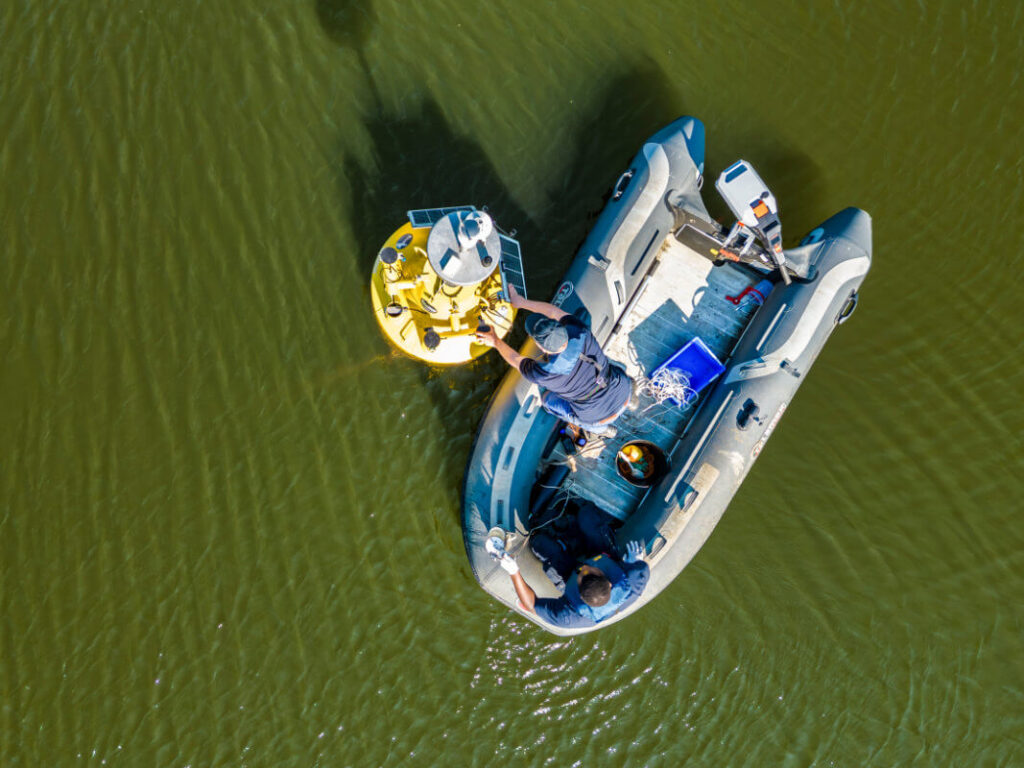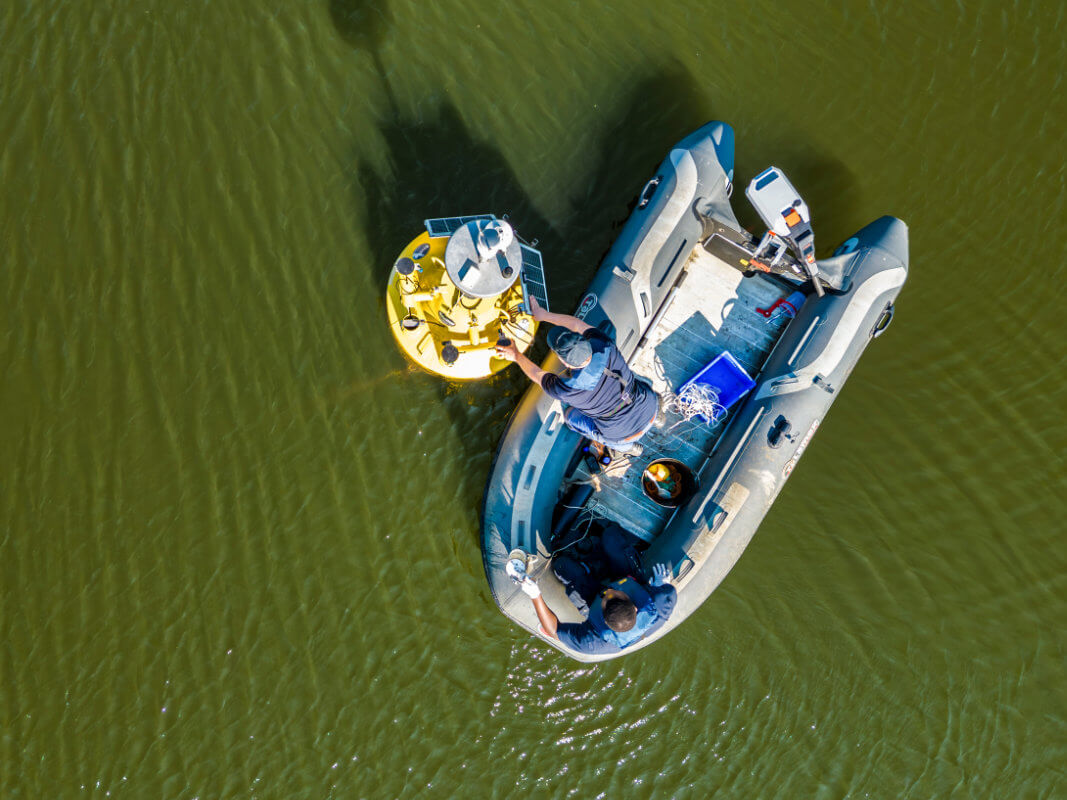
The water in Saxony’s Dröda Reservoir lies perfectly still, its surface smooth as glass. Far out on the lake, a lone yellow buoy drifts almost unnoticed. From a distance, it looks like a simple navigation marker. Up close, it becomes clear that cutting-edge research technology is in operation here. Solar panels are mounted on the buoy, antennas extend into the air and beneath the surface, sensors and measuring instruments work continuously. It is one of the measurement buoys operated by Professor Karsten Rinke and his team at the Helmholtz Centre for Environmental Research (UFZ) in Magdeburg. The system records water quality data around the clock and transmits it directly to the researchers’ laboratory via the mobile network.
Professor Rinke has headed the Department of Lake Research at the UFZ since 2010. Together with his team, he studies lakes and reservoirs worldwide to understand how climate change affects bodies of water and aquatic ecosystems.
The buoys play a central role in this work. They measure water turbidity, conductivity, temperature and levels of algae or cyanobacteria. For the researchers, remote access to this information is essential. “There are few fields of research where so much work is done outdoors as in water and lake research,” says Rinke. “We work on remote lakes, reservoirs, and rivers that are far from infrastructure. At the same time, we rely on a continuous data stream.” According to the scientist, a reliable mobile network has now become an important component of his research.
In the past, the team often had to travel to measurement sites to manually retrieve data or check whether equipment was still functioning if transmissions failed. This involved significant logistical effort and time.
“Being able to access data remotely also allows us to carry out ad hoc analyses,” Rinke explained. This is particularly important during events such as floods or heatwaves, when water conditions can change within hours or days.
The modern buoys used for around ten years by the UFZ are modular systems. Depending on the research objective, different sensors and components can be added, allowing the set ups to be adapted flexibly to different environments and research tasks.
At the same time, continuous data availability is opening up new possibilities in lake research. One of the key goals is to predict how water bodies will develop over time, which is only possible with reliable, long-term datasets. Accurate models for phenomena such as algal blooms, oxygen depletion or the effects of extreme weather can only be developed when comprehensive data is available.
The Rappbode Reservoir in Saxony-Anhalt perfectly illustrates the importance of this approach. Seven measuring stations operate there, positioned throughout the main reservoir, its tributary areas, and upstream barriers. Today, this data is no longer used exclusively by researchers. The operator also relies directly on it for daily water management, adjusting flows between basins to maintain stable, safe water quality. All measurements are available online and in near real time.
Today, mobile communications form a vital link between the field and the laboratory. Because network availability is so critical, the UFZ even employs staff specifically to assess coverage before installing new measuring stations. “The Mobilfunk-Check app is a valuable tool that saves us a great deal of time and effort,” says Rinke.